Conservation Status
IUCN Listing:
ENDANGERED
IUCN Red List of Threatened Species 2015
Australian Government
VULNERABLE
Environment Protection and Biodiversity Conservation Act 1999
Queensland
VULNERABLE
Nature Conservation Act 1992
Western Australia
VULNERABLE
Wildlife Conservation Act 1950
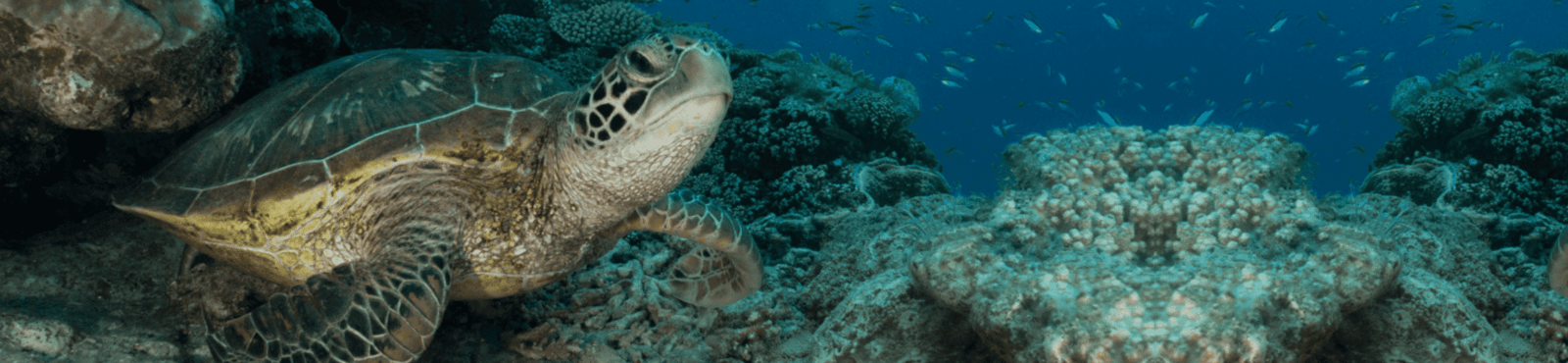
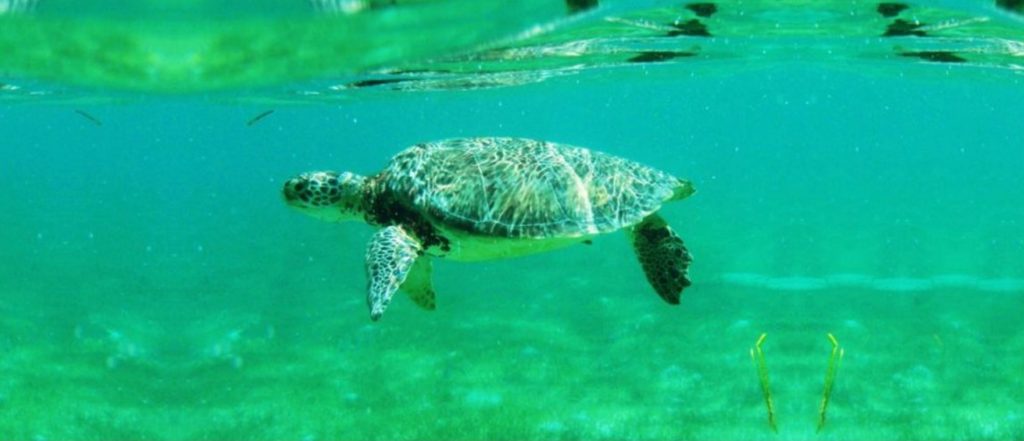
GREEN TURTLES (CHELONIA MIDAS)
Green sea turtles are among the most abundant marine turtle species in Australia, known for inhabiting tropical and subtropical waters worldwide. It is the only sea turtle known to have two types, the Atlantic green and the Eastern Pacific (found in Australia). It has not been proven whether these are two distinctly different species or subspecies. Further research is being conducted in this area.
Although many think they receive their name from the colour of their carapace (shell) which can be brown to olive green in colour, they derive their name from the greenish colour of their skin. They can also be distinguished from their high domed, smooth heart-shaped carapace. Additionally, they have 4 costal scutes (scales) along their carapace and 2 prefrontal scutes between their eyes.
They can weigh up to 317.5 kg (700 lbs) and measure up to 1.5 m (5 ft). Making them one of the largest sea turtles in the world.
Hatchlings are black to dark brown in colour, with a white outline along their carapace and flippers. Juvenile Green sea turtles are carnivorous, but when they enter their adult stages switch to being herbivores.
Australia is known worldwide for having one of the biggest Green sea turtle rookeries, Raine Island. Greens travel long migratory routes to reach these types of breeding beaches.
Breeding season in Australia lasts from mid-September to mid-November.
Like all turtles, Greens have many threats to their populations. The main threats are hunting, habitat destruction, by-catch from fishing and boat strikes.
Further Information
https://www.ehp.qld.gov.au/wildlife/animals-az/green_turtle.html